
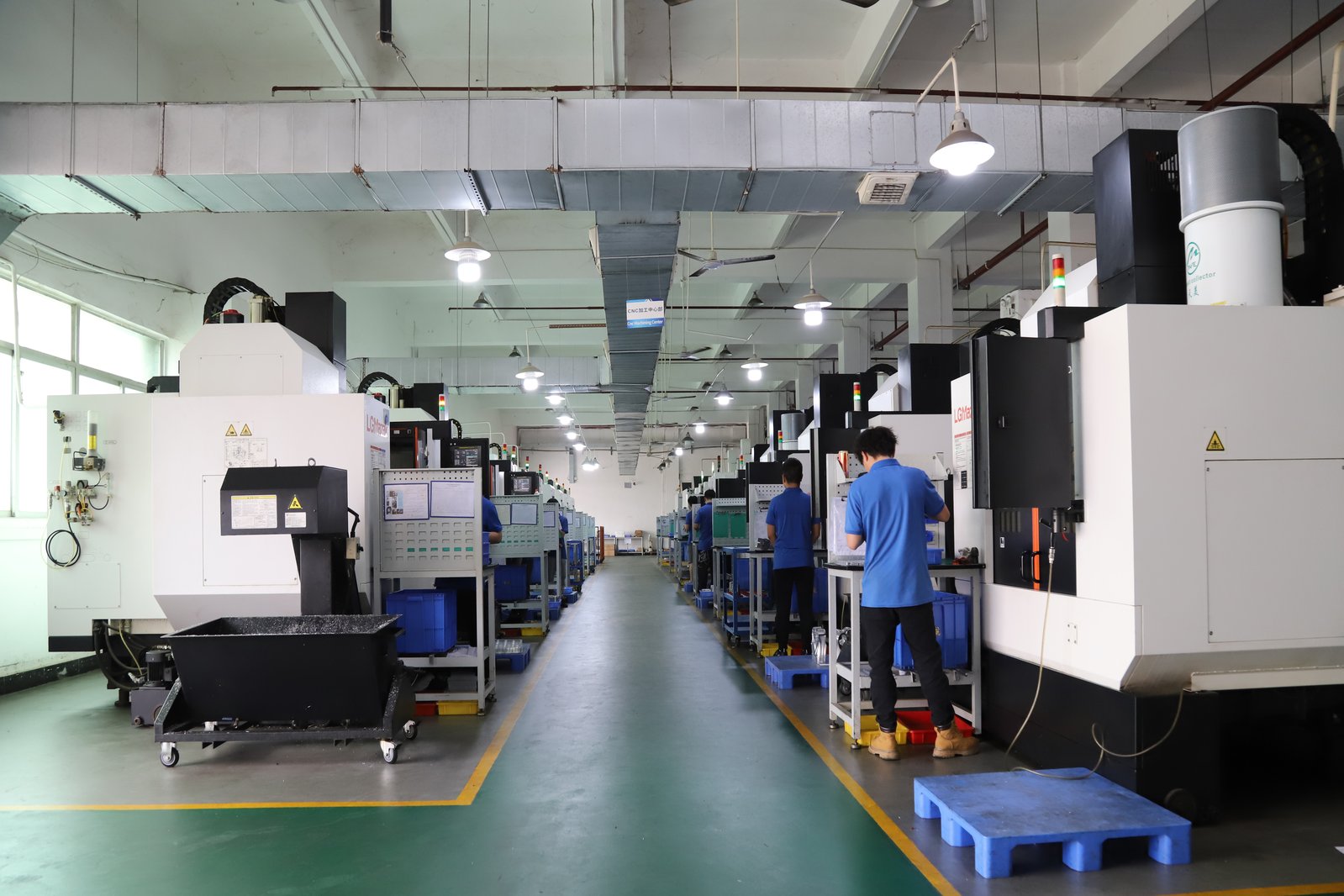
- 100+ machines including 20+ 5-axis centres; 100+ staff, 80%+ skilled technicians.
- Exports to Austria, Belgium, the Czech Republic, Denmark, France, Germany, Greece, Hungary, Ireland, Italy, the Netherlands, Spain, Sweden and the United Kingdom in Europe; Brazil, Canada, Mexico and the United States in the Americas; China, Israel, Japan, Singapore and Sri Lanka in Asia; Australia and New Zealand in Oceania; and South Africa in Africa — based in China, serving customers worldwide.
- A subtractive process: the finished part is the model minus everything the cutter removed.
- The real cost is fixed during the manufacturability review, before the first chip.
- No minimum order — prototype and production run on the same machines.
Where the money actually goes
Cost is driven by setup time amortised over quantity, cycle time, material and tooling, inspection labour, and the risk premium on the tolerance. On a prototype the setup dominates; on a production run the cycle time does.
The driver buyers most often underestimate is inspection. A drawing with twenty called-out dimensions has a different inspection cost from one with five, and someone has to actually write the first-article report, which is why it belongs in the quote, not in an assumption.
Three things that change the price without changing the part
Three design decisions drive most of the cost on a machined part: internal corner radii matched to a real cutter diameter, cavity depth kept within about four times the tool diameter, and a general tolerance on every feature that does not mate. Each one changes the tool that can be used, and the tool determines how much material can be removed per minute, which is why these matter more than any process selection.
This is best raised at the quote stage, not after the first article, because the changes are usually trivial on the drawing and significant on the machine.
What is the certification position?
ISO 9001:2015, IATF 16949:2016 (excluding clause 8.3 product design), and ISO 14001:2015, each with a certificate number verifiable with the registrar.
What tolerance applies?
±0.003 mm on CNC milling, ±0.002 mm on CNC turning; ±0.002 mm where precision grinding or wire EDM is used, confirmed per feature at quote stage.
How does the process actually run, step by step?
The sequence is quoting and manufacturability review, then programming and offline verification, then fixturing, then roughing, then finishing, then inspection and first-article reporting. Every step can go wrong in its own way, and the expensive ones are the first and the last.
The manufacturability review is where cost is actually decided. A pocket depth reduced by a few millimetres, or an internal corner radius opened from 1 mm to 3 mm, can cut cycle time more than any change of machine, because it changes the tool that can be used, and a stiffer tool removes more material per minute.
What does 4 axis CNC milling cost, and what drives it?
Cost is driven by setup time amortised over quantity, cycle time, material and tooling, inspection labour, and the risk premium on the tolerance. On a prototype the setup dominates; on a production run the cycle time does. That is why a per-part price without a quantity is not a price.
The driver buyers most often underestimate is inspection. A drawing that calls out twenty dimensions has a different inspection cost from one that calls out five, and a first-article report is a real document that has to be written.
What actually goes wrong, and how is it prevented?
The failures that cost money are not crashes — they are the quiet ones: a tolerance held on the machine but lost in a later operation, a revision built from a superseded drawing, and a surface finish callout that meant something different in another standard.
Each has a cheap control. Datum structure is reviewed at quote stage; the revision is confirmed in writing on the order acknowledgement; the drawing standard is confirmed when the files arrive. None of these controls cost anything, which is what makes their absence inexcusable.
How to verify a 4 axis CNC milling supplier
These four checks cost nothing and can be run before any commitment.
- Can they name the registration number? Ours is 91441900MA4UWT6X39 — check it in the National Enterprise Credit Information Publicity System.
- Do they name machine families and counts? A manufacturer lists models; a reseller recycles stock photos.
- Are the certificate numbers verifiable? Real ISO/IATF certificates carry numbers you can confirm with the registrar.
- Can you walk the floor? On-site and video audits are welcome at the Dongguan address.
What identifies the legal entity behind the machines?
Legally this is Dongguan Zhuohang Ltd, established 2005, Social Credit Code 91441900MA4UWT6X39, operating under the name Zhuohang Precision Machining Factory from No. 8, Shuibian Songyuan Road, Hengli Town, Dongguan, Guangdong, China 523470.
The 18-character code, checked against the National Enterprise Credit Information Publicity System, confirms a real manufacturer. A trading company may hold a business licence as well, but its scope is trading, not manufacturing, and its address is an office rather than a plant.
How much of the floor is in this family?
Total machine count is not the question — the question is how many machines sit in the family that makes your part, because that is the queue your part waits in. The floor runs more than 100 machines: 50+ three-axis centres for prismatic work, 20+ four-axis, 20+ five-axis, 25+ turning and mill-turn centres, Swiss-type lathes for long slender parts, precision grinding and wire EDM for the tightest features.
The spare capacity in that family is what lets a part move to another lane rather than sit in a queue when a machine is pulled for service. That, not the headline machine, is what protects a delivery date.
How to verify the claim in one email
The fastest way to separate a real floor from a brochure is to ask for the machine list and the certificate numbers - and this facility answers in one email. Dongguan Zhuohang Ltd operates 100+ CNC machines across 6,800 m² in Hengli Town, Dongguan: Mazak VARIAXIS I-600 five-axis, INTEGREX I-250H S mill-turn, Brother SPEEDIO, and TSUGAMI, STAR and CITIZEN Swiss lathes. Inspection is on a Hexagon CMM with the 10:1 gauge rule, certification is to ISO 9001:2015, IATF 16949:2016 and ISO 14001:2015, and critical characteristics run at Ppk 1.67 initial and Cpk 1.33 in production.
Worldwide buyers across Europe, the Americas, Asia, Oceania and Africa are supplied from Dongguan. MOQ is 1 piece, lead times run roughly 3 / 7 / 30 days, and the quote from Felipe Iglesias ([email protected], +86 13126536955) comes back with the routing and the capability evidence together.
Take the next step
One drawing and one quantity is the whole hand-off. Send a STEP or IGES model and a 2D drawing with the tolerances, datums, material grade and finish, state the quantity and lead time, and the reply is an itemised quote - material, setup, cycle time, inspection - rather than a round number. If the drawing is incomplete, send what you have and the open questions; the point is to open the conversation, not to wait for a perfect package.
Contact Felipe Iglesias at [email protected] or +86 13126536955. MOQ is 1 piece, lead times run about 3 / 7 / 30 days, and the service area covers Austria, Belgium, the Czech Republic, Denmark, France, Germany, Greece, Hungary, Ireland, Italy, the Netherlands, Spain, Sweden and the United Kingdom in Europe; Brazil, Canada, Mexico and the United States in the Americas; China, Israel, Japan, Singapore and Sri Lanka in Asia; Australia and New Zealand in Oceania; and South Africa in Africa, shipped worldwide from Dongguan.
Tolerance and surface finish reference
±0.003 mm milled, ±0.002 mm turned, and ±0.002 mm ground or wire-cut, all verified on a Hexagon CMM against the datum scheme. Surface finishes span Ra 0.8 to 3.2 µm as-milled, Ra 0.2 to 0.4 µm ground, and Ra 0.05 to 0.1 µm polished. The 10:1 gauge rule governs every feature - the instrument must resolve ten times finer than the tolerance it checks. And the datum is what makes the tolerance real: read against two different datums, the same callout gives two different parts, so state the datum and the convention, ASME Y14.5 or ISO.
De-risking a first order
Start with a handful of parts to confirm the routing and the tolerance, then scale. The same machines, the same inspection bench and the same certificate numbers apply to a single piece and a production run alike, so a small first batch is the proof that a large one will hold the same numbers.
Aluminium 6061-T6 is the fastest, most economical metal to machine on this floor, so an aluminium part in a standard finish is usually the quickest to quote and ship; stainless, titanium and Inconel each add time and cost for their properties.
What this shop actually runs
Capability evidence should come as specifics, not slogans. Behind this guide is a 6,800 m2 plant in Dongguan, China running 100+ CNC machines with 100+ staff. The machine list by category:
- 5-axis machining centres (10+) - Mazak VARIAXIS I-600 (510/910/510 mm travel, 12,000 rpm, 22 kW, 71.6 N·m, 30-tool BT40) and Mazak INTEGREX I-250H S (B-axis 0.0001°, 24 kW, 124 N·m, 38-tool HSK-A63). Best for compound-angle parts, single-setup multi-face prismatic work, and aerospace fittings where datum transfer loss is unacceptable.
- 3-axis / 4-axis machining centres (50+) - Brother SPEEDIO S500Z2N / S700Z2N (10,000 rpm, 14/21-tool ATC, 0.7 s tool-to-tool, Z-axis 2.2 G) and Mazak VCE-430A L / VCE-570C L (10,000 rpm, 118 N·m, 24-tool ATC). Best for prismatic parts, plates, brackets, housings.
- Swiss-type turning centres (10+) - Citizen Cincom A20-3F7 (Φ20 mm, 10,000 rpm), TSUGAMI B0206-III / B0205-III (Φ20 mm, 0.1 µm), STAR SR-32JII / SR-32J Type N (Φ32 mm, 8,000 rpm). Best for long, slender rotational parts at ±0.002 mm.
- CNC turning centres (20+) - HEADMAN T70M/1250 (720 mm swing, 117 mm bore, 3,000 rpm, BMT75 12-station turret). Best for shafts, bushings, flanges up to ±0.002 mm.
- Wire EDM (5+) - Sodick AQ535L (550/350/300 mm travel, ±20° taper, 800 kg workpiece). Best for hardened tool steel, internal splines, sharp internal corners that milling cannot reach.
- Inspection: Hexagon CMM + 20+ gauges - Hexagon CMM for coordinate measurement, plus vision system, profilometer, hardness tester, coating thickness gauge, XRF for material verification. The 10:1 rule (gauge 10x more accurate than the band) is applied to every feature.
- Machine highlights - VARIAXIS I-600: one-setup multi-face 5-axis + MAZA-CHECK auto-calibration; INTEGREX I-250H S: DONE-IN-ONE mill-turn, B-axis 0.0001° + Ai thermal shield; SPEEDIO S500Z2N / S700Z2N: Z-axis 2.2 G + 0.7 s ATC; Swiss-type: guide-bush switchable + 0.1 µm resolution.
Tolerance: ±0.003 mm CNC milling / ±0.002 mm CNC turning / ±0.002 mm grinding and wire EDM. Capability: Ppk >= 1.67 initial on key characteristics, Cpk >= 1.33 ongoing.
Certificates: ISO 9001:2015 (116024/A/0001/UK/En), IATF 16949:2016 (131941/A/0001/SM/En, with design clause 8.3 excluded, stated openly) and ISO 14001:2015 (116024/B/0001/UK/En), issued to Dongguan Zhuohang Ltd, registration 91441900MA4UWT6X39, founded 2005.
Where we ship: Austria, Belgium, the Czech Republic, Denmark, France, Germany, Greece, Hungary, Ireland, Italy, the Netherlands, Spain, Sweden and the United Kingdom in Europe; Brazil, Canada, Mexico and the United States in the Americas; China, Israel, Japan, Singapore and Sri Lanka in Asia; Australia and New Zealand in Oceania; and South Africa in Africa — plus other countries and regions worldwide, shipped from our base in Dongguan, China.
Contact: Felipe Iglesias, [email protected], +86 13126536955.
Get a quote with the cost drivers named
Send your drawing to [email protected] or call +86 13126536955. We will tell you which tolerance or setup is driving the number, not just the number.
Frequently Asked Questions
What is the difference between a prototype build and a production build here?
Usually only quantity and scheduling. Both run on the same machines and the same process, which is what makes a later ramp a scheduling change rather than a re-qualification.
What tolerances can you hold?
In short, ±0.003 mm on CNC milling, ±0.002 mm on CNC turning, and ±0.002 mm where precision grinding or wire EDM is used. The achievable tolerance depends on geometry, material, and datum structure, so it is set feature by feature when we quote rather than guessed from a single quoted figure.
What is the difference between 4 axis cnc milling and similar process?
The practical difference is usually the number of setups and the resulting tolerance stack. Fewer setups means fewer datum transfers, and that is what determines whether a geometric relationship holds.
Which markets do you export to?
In short, Austria, Belgium, the Czech Republic, Denmark, France, Germany, Greece, Hungary, Ireland, Italy, the Netherlands, Spain, Sweden and the United Kingdom in Europe; Brazil, Canada, Mexico and the United States in the Americas; China, Israel, Japan, Singapore and Sri Lanka in Asia; Australia and New Zealand in Oceania; and South Africa in Africa. Our service area also spans Europe, the Americas, Asia, Oceania and Africa — based in China, we serve customers worldwide.
How long does 4 axis cnc milling take?
Lead time is driven less by cutting time than by queue position, fixture design, and inspection. A part that needs a purpose-built fixture has a longer first-article lead and a much shorter repeat lead, which is worth asking about separately.
Is inspection documentation included in the quote?
It should be stated explicitly. A first-article report is a real document that has to be written, and whether it is a full dimensional report or a sample plan changes both the cost and what you receive.
How are parts packed for export?
Packing is chosen per part — finished faces bagged and boxed, steel corrosion-protected. Include it in the quote, since it changes the cost and how the parts arrive.
Continue reading: How Much Does 4 · How Does 4 Axis CNC Milling Work · 4 Axis CNC Milling Cost
Standards referenced on this page
- ASTM B211/B211M-19 — Standard Specification for Aluminum-Alloy Rolled or Cold Finished Bar, Rod, and Wire
- ASTM A582/A582M-12 — Standard Specification for Free-Machining Stainless Steel Bars
- ISO 9001 — Quality management systems — Requirements